

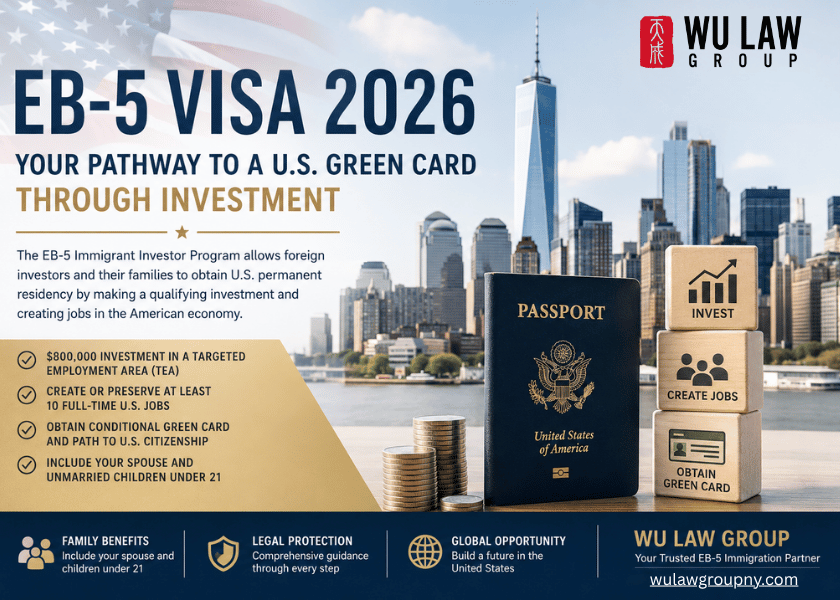
EB-5 Visa Guide 2026: Everything Investors Need to Know About the U.S. Investor Green Card Program The EB-5 Immigrant Investor Program remains one of the most powerful immigration pathways for foreign investors seeking permanent residency in the United States. In 2026, increasing global demand for U.S. residency, evolving immigration policies, and rising interest in investment-based immigration have made the EB-5 program more important than ever. For entrepreneurs, business owners, and international families, the EB-5 visa offers an opportunity to obtain lawful permanent residence while investing in the U.S. economy and creating jobs for American workers. At Wu Law Group, our immigration attorneys assist investors and families with every stage of the EB-5 process — from selecting qualifying investments and preparing source-of-funds documentation to filing immigration petitions and navigating compliance requirements. What Is the EB-5 Visa? The EB-5 visa is an employment-based immigrant visa category administered by U.S. Citizenship and Immigration Services (USCIS). The program allows eligible foreign investors and their immediate family members to obtain U.S. green cards through qualifying investments in American businesses. The purpose of the EB-5 program is to: Stimulate economic growth Create jobs for U.S. workers Encourage foreign investment in the United States Successful applicants may obtain green cards for: The principal investor Spouse Unmarried children under 21 EB-5 Investment Requirements in 2026 To qualify for the EB-5 visa program in 2026, investors must meet strict investment and job creation requirements. Minimum Investment Amount Current investment thresholds include: $800,000 investment in a Targeted Employment Area (TEA) $1,050,000 investment outside TEA-designated areas Targeted Employment Areas generally include: Rural regions High-unemployment areas Many investors pursue TEA projects because of the reduced investment threshold. Job Creation Requirement EB-5 investments must create or preserve at least: 10 full-time jobs for qualified U.S. workers These jobs must satisfy USCIS standards and remain active during the required compliance period. At Wu Law Group, we help clients understand job creation documentation requirements and evaluate whether a project satisfies immigration regulations before investment decisions are made. Direct EB-5 vs. Regional Center Investments There are two primary pathways within the EB-5 program. Direct EB-5 Investment Under a direct investment model, the investor: Establishes or purchases a business Directly manages operations Oversees employee hiring This option provides greater control but may require more operational involvement. Regional Center EB-5 Program Regional center projects are USCIS-approved investment structures that allow investors to participate in larger commercial developments. Common projects include: Hotels Residential developments Commercial real estate Infrastructure projects Advantages may include: Passive investment opportunities Indirect job creation calculations Simplified business management responsibilities Before investing, it is important to conduct proper due diligence regarding project risk, developer history, and financial structure. Source of Funds Documentation One of the most important parts of an EB-5 petition is proving that investment funds were obtained lawfully. USCIS requires extensive documentation showing how the capital was earned or acquired. Common lawful sources include: Business income Employment earnings Real estate sales Gifts from family members Inheritance Investment gains Supporting evidence may include: Tax returns Bank records Business ownership documents Property sale contracts Financial transfer records At Wu Law Group, we help investors organize and present source-of-funds evidence clearly and strategically to reduce delays and Requests for Evidence (RFEs). EB-5 Processing Timeline in 2026 Processing times continue to vary based on: Country of chargeability Visa availability USCIS workload Project structure The process generally includes: Filing the immigrant petition Conditional green card approval Two-year conditional residency Filing to remove conditions Some applicants already inside the United States may also qualify for concurrent filing benefits under current immigration rules. Concurrent Filing Benefits Eligible EB-5 applicants physically present in the United States may be able to file: Adjustment of Status applications Work authorization requests Advance parole travel permits This may allow investors and their families to: Remain legally in the U.S. Work during processing Travel internationally while awaiting green card approval These benefits have become increasingly valuable for investors seeking flexibility and long-term stability. Risks and Challenges in EB-5 Investments While the EB-5 program offers significant immigration opportunities, investors should understand that all investments involve risk. Potential concerns include: Project failure Delayed job creation Financial loss USCIS compliance problems Immigration delays Proper legal guidance and financial due diligence are essential before making any investment decision. Why Investors Choose Wu Law Group The EB-5 process combines immigration law, financial documentation, and investment analysis. Errors in filings or incomplete documentation can create costly delays or jeopardize immigration benefits. At Wu Law Group, we assist clients with: EB-5 eligibility analysis Project review and due diligence Source-of-funds preparation USCIS petition filings Adjustment of status applications Family immigration planning Compliance and condition removal Our goal is to help investors navigate the EB-5 process efficiently while protecting both immigration objectives and financial interests. Final Thoughts on the EB-5 Visa in 2026 The EB-5 visa remains one of the most effective pathways for investors and entrepreneurs seeking permanent residency in the United States. As immigration policies continue evolving, investors should carefully evaluate project opportunities, legal requirements, and long-term planning strategies before proceeding. Whether you are considering a regional center project or a direct investment opportunity, working with experienced legal counsel can help reduce risk and improve the likelihood of a successful outcome. If you are exploring EB-5 immigration options, Wu Law Group can help guide you through every stage of the process with experienced immigration representation tailored to your investment and family goals.

Executive Proclamation Imposing $100,000 H-1B Petition Fee
Executive Proclamation Imposing $100,000 H-1B Petition Fee On Friday, Sept. 19, 2025, President Donald J. Trump signed a Proclamation, “Restriction on Entry of Certain Nonimmigrant Workers,” that took an important, initial, and incremental step to reform the H-1B visa program to curb abuses and protect American workers. This Proclamation: Requires a $100,000 payment to accompany any new H-1B visa petitions submitted after 12:01 a.m. eastern daylight time on Sept. 21, 2025. This includes the 2026 lottery, and any other H-1B petitions submitted after 12:01 a.m. eastern daylight time on Sept. 21, 2025. Authorizes the Department of Homeland Security and the Department of State to coordinate to take all necessary and appropriate action to implement this Proclamation. U.S. Citizenship and Immigration Services has so far taken such action by issuing guidance regarding the Proclamation, available https://www.uscis.gov/sites/default/files/document/memos/H1B_Proc_Memo_FINAL.pdf . U.S. Customs and Border Protection has also issued guidance, available https://x.com/CBP/status/1969512486627095007 . The Department of State has posted guidance to all consular offices, consistent with the guidance from U.S. Citizenship and Immigration Services and U.S. Customs and Border Protection guidance. This Proclamation does not: Apply to any previously issued H-1B visas, or any petitions submitted prior to 12:01 a.m. eastern daylight time on Sept. 21, 2025. Does not change any payments or fees required to be submitted in connection with any H-1B renewals. The fee is a one-time fee on submission of a new H-1B petition. Does not prevent any holder of a current H-1B visa from traveling in and out of the United States. Further steps that will be taken to reform the H-1B program, as contemplated in the Proclamation, include: A rulemaking by the Department of Labor to revise and raise the prevailing wage levels in order to upskill the H-1B program and ensure that it is used to hire only the best of the best temporary foreign workers. A rulemaking by the Department of Homeland Security to prioritize high-skilled, high-paid aliens in the H-1B lottery over those at lower wage levels. Additional reforms are also under consideration and will be announced in the coming months. Source: USCIS. (2025, September 21). H-1B FAQ. https://www.uscis.gov/newsroom/alerts/h-1b-faq

Alien Entrepreneurs to Work in the US
Options for Alien Entrepreneurs to Work in the United States The United States has long been a destination for top talent from all over the world. Our ability to attract entrepreneurs has spurred path-breaking innovation, leading to the creation of jobs, new industries, and new opportunities for all Americans. This online resource provides an overview of some of the temporary and permanent pathways for alien entrepreneurs to work in the United States. This guide also highlights some of the most important immigration-related considerations for entrepreneurs contemplating starting or managing a business in the United States. More information is available on uscis.gov for temporary and permanent pathways as well as for the International Entrepreneur Rule and Optional Practical Training (OPT) for F-1 students. In addition, the Working in the United States section of uscis.gov provides a general guide to employment in the United States. You may wish to consult with an attorney to determine the best option for you. Key Questions to Consider When Choosing an Entrepreneur Pathway Am I required to make an investment or have an ownership interest in the start-up? Some pathways, such as the International Entrepreneur Rule, require you to have a certain amount of ownership in the start-up entity. Other pathways, such as E-2 Treaty Investor or EB-5 Immigrant Investor, require you invest. For some pathways, you may be an owner or investor, but it is not required. Am I required to have a certain role or position in the start-up entity? Some pathways require that you have a certain role or position in the start-up entity. The International Entrepreneur Rule requires you to have a central and active role in operations. E-2 requires you to have the capacity to develop and direct the enterprise. L-1A Intracompany Transferee Executive or Manager requires you to be in a managerial or executive position. H-1B Specialty Occupation requires you to work in a specialty occupation related to your degree. Other pathways, such as the O-1A nonimmigrant classification or the EB-1A first-preference immigrant visa classification, are for individuals with extraordinary ability and require you to continue to work in your field of expertise. Additional pathways are discussed in detail below. What are the requirements for the start-up entity? Some pathways have requirements for the start-up entity. For example, the International Entrepreneur Rule requires the entity to lawfully conduct business in the United States and to have been formed within the five years immediately preceding the initial application. It must also have substantial potential for rapid growth and job creation. The L-1 nonimmigrant visa classification requires the new office to have a qualifying relationship (parent, subsidiary, or affiliate) with a foreign business that employed you abroad for at least one year. Additional requirements are discussed in detail below. Do I have the education, experience, or skills needed to qualify? Some pathways, such as the O-1A nonimmigrant visa classification and the EB-1A immigrant visa classification, are for those with “extraordinary ability.” These require that a person have sustained national or international acclaim in their field of expertise. Others, such as the H-1B, require at least a U.S. bachelor’s degree in a specific specialty or its equivalent related to the position. Will I be working in the United States on a permanent basis as a lawful permanent resident, or will I be working on a temporary basis as a parolee or nonimmigrant? Some opportunities provide a basis for individuals to obtain lawful permanent resident status in the United States. Permanent resident status allows you to live and work in the United States permanently, and typically provides you with a path to U.S. citizenship. These opportunities are known as “immigrant” pathways. Other pathways, such as parole or nonimmigrant status, allow you to temporarily live and work in the United States. Although some of these nonimmigrant pathways cannot be extended indefinitely, they can provide more time to demonstrate eligibility for a permanent resident pathway. Summary of Pathways for Entrepreneur Employment in the United States For more details, see our Nonimmigrant or Parole (Temporary) Pathways for Entrepreneur Employment in the United States page. Pathway Start-up Entity Activity in United States Duration of Validity IER International Entrepreneur Rule The start-up business must be organized and lawfully conduct business in the United States and be formed within the five years immediately preceding your initial application. It must also have substantial potential for rapid growth and job creation. You must have substantial ownership, which USCIS considers to be at least 10% for initial parole and at least 5% for re-parole. You must have a central and active role in the operations. Up to 30 months of initial parole with an ability to apply for one additional period (re-parole) of up to 30 months. B-1 Temporary Business Visitor A B-1 visitor visa may be appropriate if the entity has not already been established. A B-1 visitor may come to the United States in order to secure funding or office space, negotiate a contract, or attend certain business meetings in connection with opening a new business. However, a B-1 visitor is prohibited from working for or operating an already established U.S. entity. Similarly, a B-1 visitor may not begin operating or working for a new business in the United States. Up to six months (minimum of one month) for initial stay; up to six months for extension of stay; maximum total amount of time permitted in B-1 status on any one trip is one year. E-2 Investors from Treaty Countries You must invest a substantial amount of capital and have at least 50% ownership or possession of operational control. The investment enterprise may not be marginal. A marginal enterprise is one that does not have the present or future capacity to generate more than enough income to provide a minimal living for you or your family within five years. You must develop and direct the investment enterprise. Up to two-year initial approval plus two-year extensions, with no maximum duration of status and no annual numerical limit. F-1 OPT Optional Practical Training (OPT) A student in F-1 student status may start a business. However, in order to qualify for a STEM OPT extension, the start-up entity must be an employer

USCIS Updates Fees Based on H.R.1
USCIS Updates Fees Based on H.R. 1 Release Date 07/18/2025 U.S. Citizenship and Immigration Services is publishing a federal register notice (FRN) based on the H.R 1 Reconciliation Bill (H.R. 1). Applicants must submit the new fees with benefit requests postmarked on or after July 22, 2025. USCIS will reject any form postmarked on or after Aug. 21, 2025, without the proper fees. H.R. 1 established specific fees for various immigration-related forms, benefits, statuses, petitions, applications, and requests administered by multiple government agencies. This notice announces the new fees that are administered by USCIS. USCIS will deposit and retain a portion of the revenue from some of these fees in the Immigration Examinations Fee Account (IEFA). The remaining revenue will be deposited with the general fund of the Treasury. The FRN explains when the new fees take effect, instructions on their payment, when and if the fees may be waived, and consequences of the failure to pay. DHS must increase the fees each year based on inflation. The new fees in this FRN are: A new fee of $100 for aliens who file Form I-589, Application for Asylum and for Withholding of Removal Annual Asylum Fee (AAF) of $100 (which must be paid online) for all aliens with a pending Form I-589 for each calendar year their application remains pending. A new fee for aliens who file Form I-765, Application for Employment Authorization, for asylum, parolee, and Temporary Protected Status (TPS) categories. The categories are (a)(4), (a)(12), (c)(8), (c)(11), (c)(19), and (c)(34). The fees are: For initial EAD applications, $550; and For renewal or extension EAD applications, $275. There is one exception to these fees. If an alien requests an EAD after we approve a new period of parole (re-parole) by filing Form I-131, Application for Travel Documents, Parole Documents, and Arrival/Departure Records, the fee will be the lower H.R. 1 fee of $275; A new Special Immigrant Juvenile fee of $250 for any alien who files a Form I-360, Petition for Amerasian, Widow(er), or Special Immigrant, as a special immigrant juvenile; and Increasing the maximum cost to register for TPS using Form I-821, Application for Temporary Protected Status, from $50 to $500. Any alien who filed or files a Form I-589 after October 1, 2024, that remains pending with USCIS for 365 days must pay the AAF is of the one-year anniversary of his or her filing date and each year thereafter that the application remains pending on such day of the calendar year. For the first time the AAF is due, aliens who file for asylum do not need to monitor the time their application has been pending and if the AAF applies to them. USCIS will issue personal notices to aliens when their annual asylum fee is due, which will include the amount of the fee, when it must be paid, how the fee must be paid, and the consequences of failing to pay. USCIS will provide guidance for future years’ AAF payments in subsequent issuances. H.R. 1 also changed validity periods for some EAD categories. For alien parolees, initial employment authorization is valid for a period of no more than one year or for the duration of the alien’s parole, whichever is shorter. For aliens with TPS, initial and renewal employment authorizations are valid for no more than one year or for the duration of the alien’s TPS status, whichever is shorter. USCIS will add the fees listed in H.R. 1 to the fees in 8 CFR part 106. Each fee must be submitted separately. That means that the fees in H.R. 1 do not supersede or replace those promulgated by the USCIS Fee Rule, rather they will be charged “in addition” to current fees. If the requestor is eligible for a fee waiver for the existing fees under 8 CFR 106.3(a), he or she may submit Form I-912, Request for Fee Waiver, or a written fee waiver request, in addition to the H.R. 1 fee. The new H.R. 1 fees cannot be waived or reduced. The FRN does not cover all the new fees required by H.R. 1. DHS will announce implementation of fees not covered in this FRN in a future action. These forms have associated fee changes that are not included in this FRN: Form I-131, Application for Travel Documents, Parole Documents, and Arrival/Departure Records; and Form I-102, Application for Replacement/Initial Nonimmigrant Arrival-Departure Document. Source: USCIS. (2025, July 18). USCIS Updates Fees Based on H.R. 1. https://www.uscis.gov/newsroom/alerts/uscis-updates-fees-based-on-hr-1

Trump Administration Releases Details on Proposed Gold Card Immigration Program
Trump Administration Releases Details on Proposed Gold Card Immigration Program On Sept. 19, 2025, the Trump administration published additional details about the proposed Gold Card program. The https://trumpcard.gov website went live with new information, outlining three categories of programs: The Gold Card: Requires a USD $1 million contribution for permanent residency. The website states that the Gold Card is based on the individual’s ability to substantially benefit the United States. Notably there are no tax provisions; applicants would remain subject to worldwide income taxation. The Platinum Card: Requires a USD $5 million contribution and allows the holder to reside in the United States for up to 270 days per year without being subject to tax on non-U.S. income. This would replace other temporary visas. The Trump Corporate Gold Card: Allows a U.S. business to make a USD $2 million contribution to transfer an employee to the United States. This benefit may be transferable to another employee for a fee. The website states that processing fees and background vetting will occur for all three card types, although no information about the fees or the process has been posted as of the date of this blog. The site also indicates that contributions will be made to the U.S. Department of Commerce, but no information is available about how those funds will be used by the U.S. government. Importantly, this contribution differs from the EB-5 program, where investors may eventually recover their investment funds depending on the success of the business. It also unclear whether the “vetting” will involve a background check, proof of the source of funds ( as required in the EB-5 program), or both. Moreover, there is no mention of dependent applicants or whether family members of the main applicable will receive benefits under the program. Of particular interest is a statement on the website that a Gold Card will be either an EB-1 or EB-2 preference green card. These categories, and their underlying subcategories of permanent residence, are statutorily authorized by Congress and have specific visa number allocations. It is possible this designation could be challenged in court as outside the authority of the Executive Branch. Additionally, applicants born in Mainland China and India may face significant visa backlogs, as these delays already exist in the EB-1 and EB-2 preference categories. At this time, it is unknown when the fees or application instructions will be released to the public. Based on the lack of information regarding requirements, fees, process, and timelines, it does not appear that applicants can apply yet. Source: Jennifer Hermansky. (2025, September 22). Trump Administration Releases Details on Proposed Gold Card Immigration Program. https://www.eb5insights.com/2025/09/22/trump-administration-releases-details-on-proposed-gold-card-immigration-program
Recent H-1B Rule Extends F-1 Cap-Gap Extension
Recent H-1B Rule Extends F-1 Cap-Gap Extension If you are an F-1 student planning to transition to H-1B employment, recent changes to the H-1B program may directly impact you. As of January 17, 2025, DHS implemented a final H-1B rule that extends the cap-gap extensions of eligible F-1 students from October 1 to April 1 of the relevant fiscal year. The cap-gap period previously ended on October 1. With this extension, the cap-gap period now ends April 1 of the relevant fiscal year. This rule will be applied to eligible F-1 students who are a beneficiary of a timely filed H-1B cap-subject petition beginning with the FY 2026 H-1B registration period. What Is the Cap-Gap Extension? The “cap-gap” refers to the period between the expiration of an F-1 student’s program of study (or optional practical training (OPT) and the start of H-1B employment. To bridge this period, DHS has historically allowed an automatic extension of F-1 status and employment authorization for students with a timely filed cap-subject H-1B petitions, but only up to October 1. What Has Changed? Under the new H-1B rule, the cap-gap extension has been expanded. Eligible F-1 students may now receive an automatic extension of both their F-1 status and work authorization until April 1 of the fiscal year for which the H-1B petition is filed. This change is intended to provide added flexibility for foreign students and prevent disruptions in lawful status or employment authorization that may occur due to delays in USCIS adjudication or processing timelines. Who Is Eligible? You may qualify for extended cap-gap if: You are in a valid period of F-1 status (to be eligible for an extension of employment you must be in a valid period of post-completion OPT or science, technology, engineering and mathematics (STEM) OPT. You have not violated the terms or conditions of your immigration status. You are a beneficiary of a timely filed cap-subject H-1B petition that requests the following: A change of status to H-1B and not consular processing; and An employment start date in the fiscal year for which such H-1B status is being requested If the H-1B petition is denied, withdrawn, rejected or revoked, the automatic cap-gap extension is terminated immediately. In such cases, the foreign student is no longer authorized to work in the United States under F-1 status and has a 60-day grace period to prepare for departure. For further guidance, consult your designated school official to ensure you meet all requirements and deadlines. Source: U.S. Department of Homeland Security. (2025, April 25). Recent H-1B Rule Extends F-1 Cap-Gap Extension. https://studyinthestates.dhs.gov/2025/04/recent-h-1b-rule-extends-f-1-cap-gap-extension
