For many immigrants, one of the most meaningful milestones after becoming a U.S. citizen is reuniting with their parents. Family-based immigration allows eligible U.S. citizens to sponsor their parents for lawful permanent residence, making it possible for families to live together in the United States.
Although the process is generally straightforward compared to many other immigration categories, filing errors, missing documentation, or eligibility issues can lead to costly delays.
At Wu Law Group, we help families throughout New York navigate the parent green card process with personalized legal guidance from start to finish.
Yes. U.S. immigration law allows U.S. citizens who are at least 21 years old to petition for their biological or adoptive parents to become lawful permanent residents.
Parents are considered immediate relatives, which means they are not subject to annual visa limits. As a result, they generally do not have to wait for a visa number to become available.
However, lawful permanent residents (green card holders) cannot sponsor their parents until they become U.S. citizens.
To sponsor your parents, you must generally:
Depending on your family’s circumstances, additional documentation may also be required.
Although every case is unique, applicants commonly submit:
Supporting documents must be accurate, complete, and translated into English if originally issued in another language.
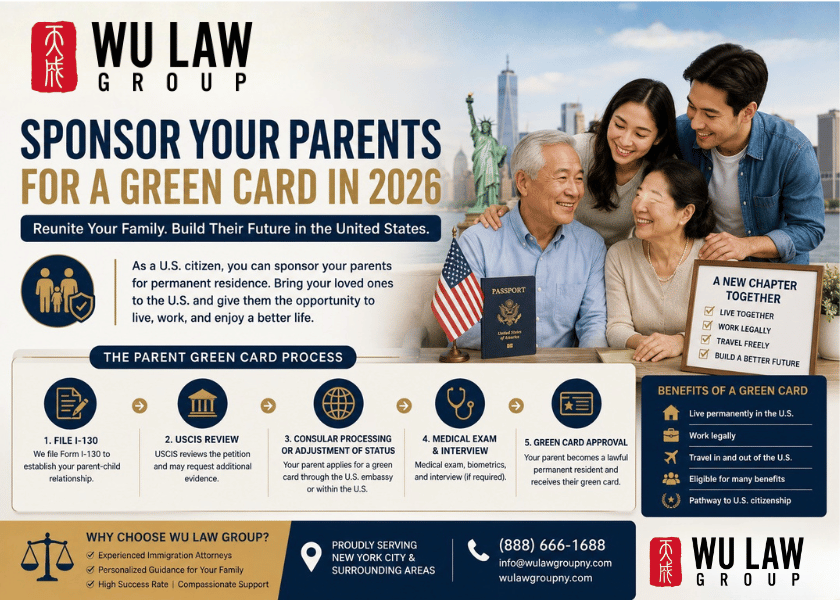
The immigration process generally includes several important steps.
The U.S. citizen files Form I-130, Petition for Alien Relative, with USCIS.
This establishes the qualifying parent-child relationship.
USCIS reviews the petition and may request additional documentation if necessary.
Responding promptly to any Request for Evidence (RFE) helps prevent unnecessary delays.
If the parent is already legally present in the United States and eligible, they may apply for Adjustment of Status.
Parents living abroad generally complete the immigration process through a U.S. embassy or consulate.
Most applicants complete:
After approval, the parent becomes a lawful permanent resident and receives a green card.
Processing times vary depending on:
While immediate relatives avoid visa backlogs, careful preparation remains important to avoid unnecessary delays.
Many applications are delayed because of avoidable errors.
Some of the most common include:
Missing birth certificates, marriage records, or translations often delay processing.
The petitioner must demonstrate sufficient financial ability to support the parent by submitting Form I-864, Affidavit of Support.
Submitting outdated forms or incomplete applications may result in rejection or Requests for Evidence.
Foreign-language documents must generally be accompanied by certified English translations.
Working with an experienced immigration attorney can help ensure that applications are complete and properly organized before filing.
After becoming lawful permanent residents, parents generally have the right to:
Permanent residency also provides greater long-term security and stability for families.
Family reunification is one of the most rewarding areas of immigration law, but every family’s situation is different.
At Wu Law Group, our immigration attorneys help clients with:
We work closely with families to help simplify the immigration process while minimizing delays and avoiding common filing mistakes.
Bringing your parents to the United States as lawful permanent residents is one of the greatest benefits available to U.S. citizens. Although the process is often more straightforward than many other immigration categories, proper planning and accurate documentation remain essential.
If you are ready to sponsor your parents for a green card or have questions about your eligibility, the experienced immigration attorneys at Wu Law Group are here to guide you through every step of the process and help reunite your family.
Copyright © 2026 Wu Law Group. All Rights Reserved